Stretchable Microneedle Adhesive Patch (SNAP)
Skin Preparation-Free Electrophysiological Sensing and Exoskeleton Control
Conventional wearable electrodes lose contact during motion due to mechanical mismatch with skin. SNAP bridges this gap through a functionally graded architecture that combines rigid silicon microneedles with a soft, stretchable platform — achieving stable electrophysiological recording under 30% skin strain.
Read Paper in Science Advances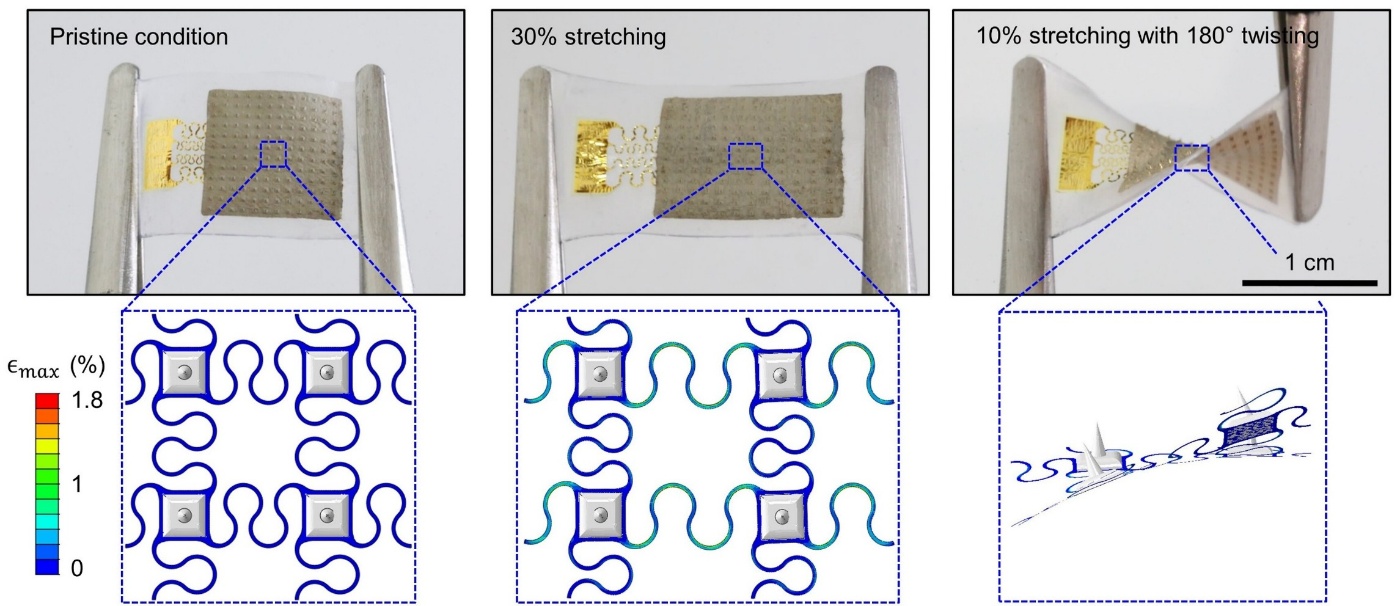
Key Findings
Stress Reduction (FME vs. SNAP)
Under 30% tensile strain, SNAP reduces peak von Mises stress from 16.27 MPa (FME) to 0.99 MPa — a 16-fold improvement. Epidermal stress drops from 0.57 MPa to 0.22 MPa.
Mechanical Compliance
The integrated device achieves an effective elastic modulus of 130 kPa, matching the physiological range of human skin (60–850 kPa). Cu interconnect strain remains at 3.3% under 30% stretch—below the ~5% fracture threshold.
Biocompatibility
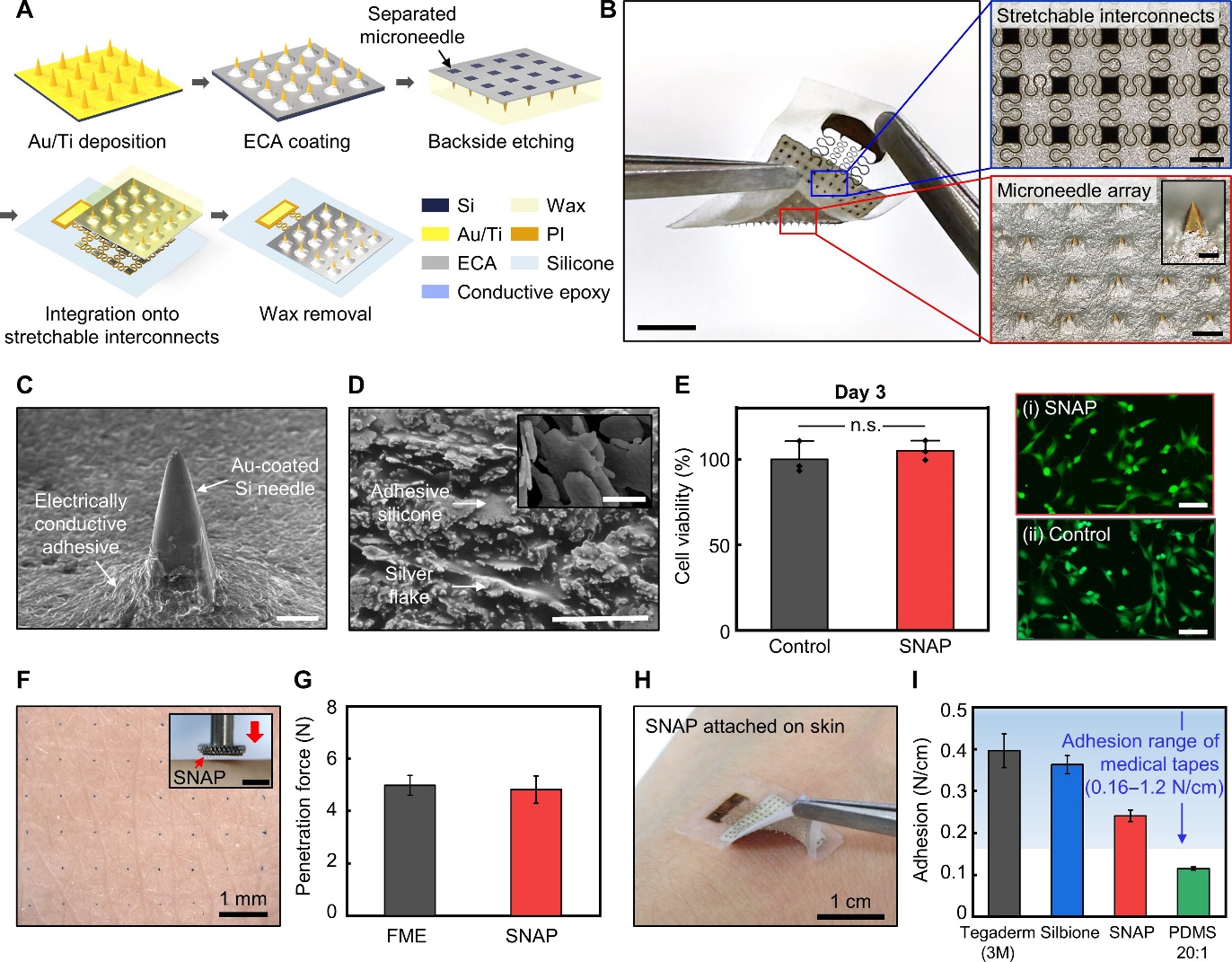
Cytotoxicity testing confirms cell viability comparable to controls at days 3 and 7. Water vapor permeability of 8.6 g/h/m² matches transepidermal water loss range. Penetration force of 4.8 N achievable with gentle finger pressure.
Wireless EMG Demonstration
Wireless SNAP system enables real-time multichannel EMG monitoring during dynamic motion. Cu interconnect strain (3.3%) remains below fracture threshold (~5%). Demonstrated as HMI for closed-loop exoskeleton robot control.
Computational Methodology
Software: ABAQUS (Dassault Systèmes) with mixed discretization — shell elements for thin metal/PI layers, solid elements for bulk elastomers and tissue.
Constitutive Models: Ogden hyperelastic for Ecoflex 00-30 and skin layers; linear elastic for silicon (E = 130 GPa); viscoelastic for ECA matrix.
Loading Conditions: 30% uniaxial tension, 30% compression, 180° twisting with 10% stretch. Boundary conditions simulate tissue anchoring with appropriate friction coefficients (μ = 0.2–0.5).
Architecture: Three-layer functionally graded system — Au-coated Si microneedles (200 μm height, <5 μm tip) + serpentine PI/Au/PI interconnects (5/0.2/5 μm) + Ag-flake/silicone ECA (45 μm) + Ecoflex encapsulation.
Publication
Kim, H., Lee, J., Heo, U., Jayashankar, D.K., Agno, K.C., Kim, Y., Kim, C.Y., Oh, Y., Byun, S.H., Choi, B., and Jeong, J.W. (2024). “Skin preparation-free, stretchable microneedle adhesive patches for reliable electrophysiological sensing and exoskeleton robot control.” Science Advances, 10(3), eadk5260.