Prosthetic Knee Intelligence System (PKIS)
Real-Time Limb-Socket Monitoring via Stretchable E-Skin and Deep Learning
Over 60% of lower-limb prosthetic users develop skin complications in their first year of use — driven by invisible pressure patterns that static fitting cannot detect. PKIS transforms the prosthetic socket from a passive mechanical interface into a continuous, intelligent monitoring platform.
Project Overview
The Problem
Lower-limb amputees lack sensory feedback at the prosthetic socket interface. Skin-related complications exceed 60% in the first year, caused by non-uniform, time-varying pressure patterns invisible to static fitting protocols.
The Innovation
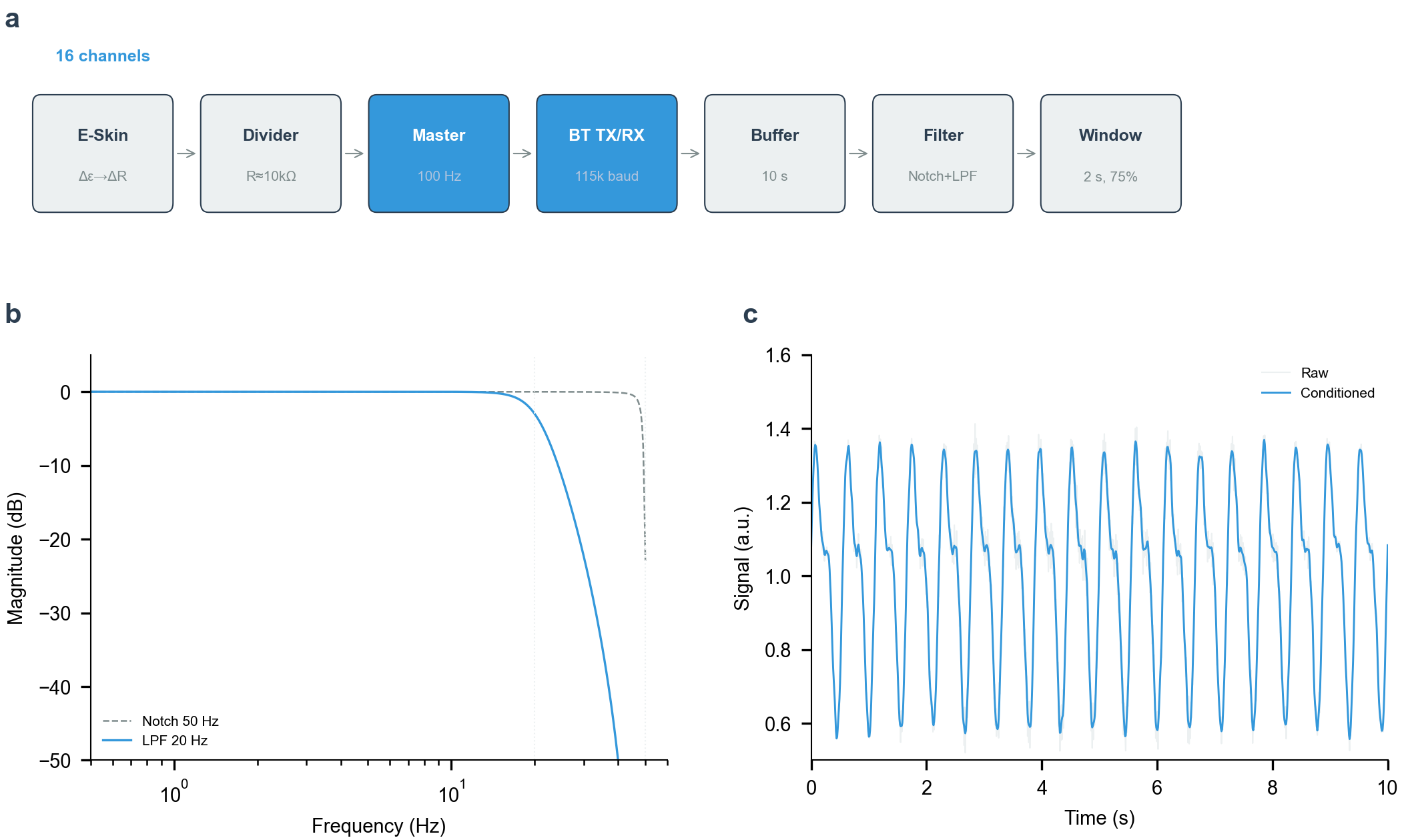
A stretchable piezoresistive e-skin (EGaIn/SiO₂/PDMS, GF≈24) embedded in the prosthetic liner, coupled with a CNN-BiLSTM-Attention multi-task deep learning framework for simultaneous activity recognition, forecasting, and risk assessment.
Key Design Choices
16-channel spatial pressure array · Dual-Arduino Bluetooth acquisition at 100 Hz · Safety-asymmetric loss weighting (λrisk = 1.5) · Synthetic-first training with real-data fine-tuning.
Clinical Impact
First end-to-end soft-sensor-to-clinical-dashboard system for prosthetic interface monitoring. Enables proactive intervention before skin breakdown occurs, with real-time attention heatmaps for clinical interpretability.
Technical Details
Collaborators
Quorum Prosthetics · RockyTech · Xiao Lab, CU Boulder
Patient testing conducted with transtibial and transfemoral prosthetic users (IRB-approved, all permissions obtained).